The Pickwick Portfolio
Little WomenThe Pickwick Portfolio is the weekly newspaper produced by the March sisters for their Pickwick Club, or “P.C.” With Jo as editor, it transforms a private Saturday gathering in the March family home into an imaginative institution with officers, badges, ceremonies, genres, and a regular readership within the family circle. The paper’s decisive significance lies in the way it gives four young women a common literary enterprise without erasing their differences: each sister assumes a club role, contributes material, and receives both admiration and good-natured correction. The Portfolio is therefore not merely a children’s pastime but a rehearsal for authorship, citizenship, friendship, and the social uses of writing.
Definition and Club Setting
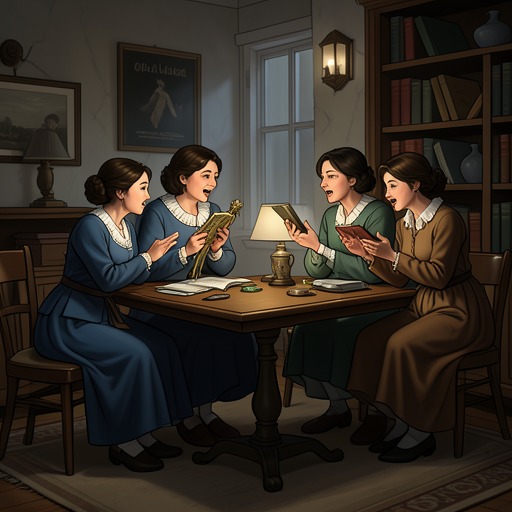
The Pickwick Club arose because secret societies were fashionable and the sisters admired Dickens. With only a few interruptions, they maintained it for a year, meeting every Saturday evening in the big garret. Three chairs stood before a table bearing a lamp, while four white badges, each marked with a differently colored “P.C.,” waited for the members. At seven o’clock the girls ascended, tied the badges around their heads, and took their seats with great solemnity. This carefully repeated ceremony gave the newspaper a formal setting: the garret became a hall, the girls became officers and literary personae, and domestic objects became the equipment of a small publishing institution.
The sisters distributed identities according to temperament. Margaret March, the eldest, served as Samuel Pickwick and presided over the proceedings. Josephine March, whose literary inclination made her the natural editor, took the role of Augustus Snodgrass. Elizabeth March, round and rosy, became Tracy Tupman, while Amy Curtis March, who was always attempting feats beyond her present ability, became Nathaniel Winkle. The assignments are comic, but they also reveal the club’s method: personality is translated into literary character, and the sisters learn to observe one another closely enough to turn habits, virtues, and faults into material.
Contents and Editorial Practice
The Portfolio contained original tales, poetry, local news, funny advertisements, and hints. Those hints allowed the sisters to remind one another of shortcomings without making criticism wholly hostile; the paper could tease, discipline, and preserve affection at the same time. Its contents thus moved between invention and domestic record, joining literary fantasy to the ordinary knowledge produced by life in the March family home. The girls did not simply consume books: they borrowed the forms of print and made them answer to their own household, friendships, quarrels, and ambitions.
A surviving issue is headed “THE PICKWICK PORTFOLIO” and dated “MAY 20, 18—.” It includes a “POET’S CORNER,” an “ANNIVERSARY ODE,” and the beginning of “THE MASKED MARRIAGE (A Tale Of Venice).” The ode celebrates the club’s anniversary, its badges and solemn rite, the health of its members, the familiar faces and friendly handclasps of the gathering, and the president reading the weekly sheet with spectacles on her nose. The Venetian tale shifts the paper into romantic historical fiction: gondolas arrive at the marble steps of Count Adelon’s palace, a masquerade fills the halls, and Lady Viola is said to be engaged to Count Antonio although she passionately hates him. The contrast between ceremonial attic life and extravagant fiction shows the Portfolio’s imaginative range; the girls can make their own small institution feel as ceremonious as a public anniversary and their own stories as ornate as a continental romance.
The newspaper also records the members’ relative qualities through a brief evaluation in which Margaret March is marked “Good,” Josephine March “Bad,” Elizabeth March “Very Good,” and Amy Curtis March “Middling.” The scale is playful rather than objective, but it makes the Portfolio a medium of collective judgment. Jo’s editorship does not place her above criticism, and the paper’s authority depends on the willingness of its members to be seen, corrected, and laughed at by one another.
Expansion Through Theodore Laurence
The Portfolio becomes a bridge between the March family home and the neighboring Laurence mansion. At a club meeting, Josephine March proposes Theodore Laurence as an honorary member, arguing that he deserves the honor, would be grateful for it, and would add spirit, literary value, and sociability to the paper. The proposal extends the club beyond the four sisters and converts a neighboring boy, previously separated from them by the low hedge and by the loneliness of his grandfather’s house, into a participant in their shared imaginative world.
Theodore Laurence answers through the club’s comic language, presenting himself as Sam Weller and offering a token of gratitude designed to promote “friendly relations between adjoining nations.” His contribution is a post office in the hedge at the lower corner of the garden, made from an old martin house whose door has been stopped up and whose roof has been opened. It has padlocked doors and room for letters, manuscripts, books, bundles, and, in the joke’s deliberately expansive phrasing, “the females.” Each nation receives a key, and the club key is placed on the table amid great applause. The physical location matters: the hedge, which marks the boundary between the two estates, is turned into a passage for communication. A dividing line becomes shared infrastructure.
The meeting continues late because every member does her best, and it ends with three shrill cheers for the new member. No one regrets Theodore Laurence’s admission. His orations become a regular source of hilarity, and his contributions to the paper may be patriotic, classical, comic, or dramatic, but never sentimental. Josephine March regards them as worthy of Bacon, Milton, or Shakespeare and remodels her own works under their influence, or at least believes she does. The exchange is therefore reciprocal: Laurence supplies a new masculine performance within the girls’ literary world, while Jo’s editorial practice absorbs and reshapes it.
Circulation and Material Exchange
The hedge post office gives the Portfolio a life beyond the Saturday meeting. It carries not only writing but the varied materials of social life: tragedies and cravats, poetry and pickles, garden seeds and long letters, music and gingerbread, rubbers, invitations, scoldings, and puppies. The list makes the institution comic, but it also demonstrates how writing operates within a network of objects, favors, messages, and obligations. The newspaper belongs to a larger system of exchange in which affection can travel alongside food, clothing, household items, and manuscripts.
The old gentleman joins the play by sending odd bundles, mysterious messages, and funny telegrams. The gardener, attracted to Hannah Mullet, even sends a love letter into Jo’s care. The Portfolio and its post office thus create a controlled channel through which relationships can be initiated, tested, hidden, and revealed. The joke about how many love letters the little post office will hold in future years gives the object a faint anticipatory power: its present function as children’s infrastructure foreshadows a later world in which correspondence will carry more serious emotional meanings.
Literary Apprenticeship and Lasting Significance
The Portfolio is part of Josephine March’s early apprenticeship in writing. Her editorial position allows her to practice selection, arrangement, revision, satire, and the management of contributors. The club’s productions also teach her that authorship is social rather than solitary: stories and poems emerge from collaboration, criticism, performance, and the pressure of an audience. Even the paper’s bad or middling judgments become useful because they expose writing to response instead of allowing it to remain a private fantasy.
The newspaper’s social reach also anticipates the broader network that surrounds the sisters. At a later outdoor gathering connected with the Laurence family, guests include young people of differing temperaments, social ease, and physical abilities. Frank Vaughn, using a crutch and separated from the active boys, asks Elizabeth March to talk with him because sitting alone is dull; her hesitant decision to remain and converse illustrates the same principle that governs the Portfolio. Communication brings the isolated person into fellowship. The paper’s importance rests less on literary polish than on its ability to make participation possible.
That principle remains visible in the later educational world Josephine March helps create at Plumfield. There, boys of different abilities and circumstances—including slow, bashful, feeble, riotous, lame, stammering, and otherwise excluded children—are welcomed into a “happy, homelike place” devoted to teaching, care, and kindness. The Pickwick Club is a small and comic precursor to that larger institution. In the garret, the sisters practice making room for one another’s voices; through the hedge post office, they extend that room to Theodore Laurence; at Plumfield, the same ethic becomes a durable community. The Portfolio’s lasting significance is consequently both literary and social: it turns domestic play into authorship and authorship into a form of belonging.